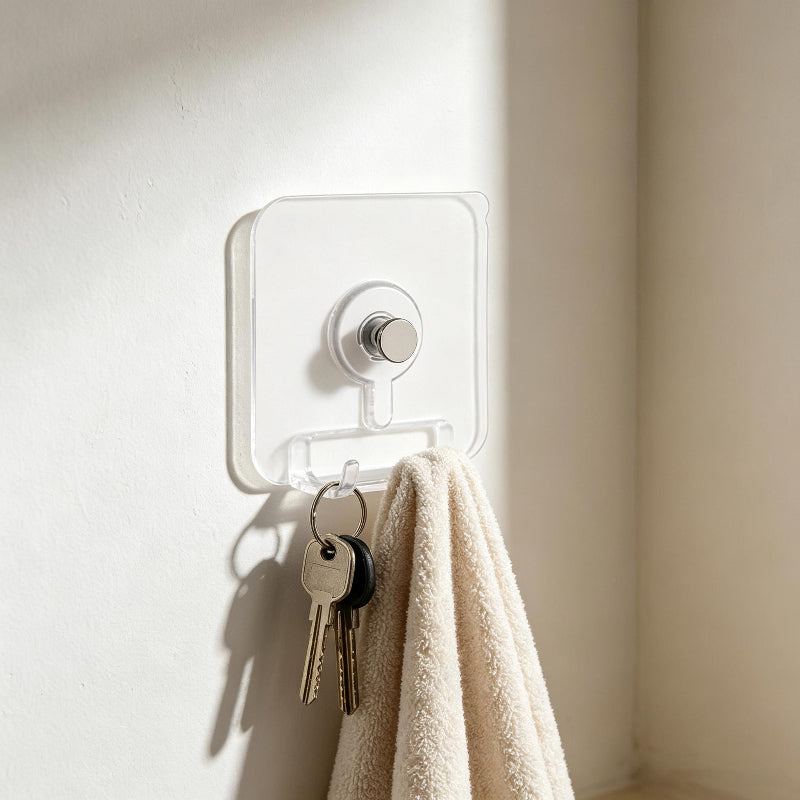
Can You Use Adhesive Hooks on Painted Walls
Can You Use Adhesive Hooks on Painted Walls
Couldn't load pickup availability
Yes, adhesive hooks can be used on some painted walls, but a painted surface is not automatically suitable for every adhesive hook.
The condition of the paint, surface texture, cleanliness, moisture, and the hook's intended application all affect the result. A smooth, clean, dry, firmly bonded painted surface is generally a better candidate than paint that is peeling, chalky, heavily textured, or otherwise unstable.
Before sticking a hook to your wall, check the surface first. That simple step can help you avoid both poor adhesion and unnecessary paint damage.
Yes, But the Condition of the Paint Matters
The important question is not simply whether the wall is painted. It is whether the painted surface can provide a stable surface for the particular adhesive product you plan to use.
A smooth painted wall in good condition is generally easier to work with. The paint should be firmly bonded to the wall rather than lifting, flaking, or leaving powdery residue.
Problems are more likely when the surface has:
- Peeling or loose paint
- A chalky or powdery finish
- Heavy texture that limits adhesive contact
- Dust, grease, moisture, or other residue
- Existing surface damage
- Paint that has not adequately cured
Product instructions should always take priority because adhesive systems differ in their supported surfaces and application requirements.
Check Your Painted Wall Before You Buy or Install a Hook
You do not need complicated testing to make a useful first assessment.
Start by looking closely at the area where you want to install the hook. Is the paint intact, or are there cracks, flakes, bubbles, or areas that appear loose?
Next, consider the texture. A relatively smooth surface can provide more consistent contact than heavily textured paint.
The surface should also be clean and dry. Dust, grease, moisture, and residue can interfere with the adhesive's contact with the surface.
If the wall was recently painted, do not assume that the paint is ready simply because it feels dry. Follow the paint manufacturer's curing guidance and the adhesive hook manufacturer's instructions before applying the product.
If the paint itself appears unstable, an adhesive hook is usually not the right solution for that location.
Will an Adhesive Hook Damage a Painted Wall?
It can.
The risk depends on the adhesive product, the condition and adhesion of the paint, how the hook is installed, the load placed on it, and how it is eventually removed.
This is why claims such as “works on every painted wall” or “will never damage paint” should be treated cautiously.
A hook may remain securely attached while the paint underneath it is relatively weak. In that situation, the limiting factor is not necessarily the hook's adhesive strength. The paint layer or underlying surface may fail first.
Removal also matters. An adhesive hook that works well during use can still cause problems if the product is removed incorrectly or if the paint is poorly bonded.
If protecting the wall is especially important, choose a product specifically intended for the surface and application, and follow its installation and removal instructions carefully.
What About Textured, Old, or Recently Painted Walls?
These situations need a little more attention.
Textured paint: Heavy texture can make it harder for an adhesive to maintain consistent contact with the surface. Check whether the particular product is intended for that type of finish rather than assuming that all adhesive hooks will work.
Old paint: The age of the paint alone does not determine whether an adhesive hook will work. A properly maintained older painted wall can be a better candidate than a newer wall with loose or poorly bonded paint. Focus on the condition of the surface.
Recently painted walls: Give the paint adequate time to cure according to the paint manufacturer's guidance. A surface that is dry to the touch is not necessarily ready for every adhesive application.
How to Get Better Results on a Painted Wall
Once you have confirmed that the surface is suitable, follow the hook manufacturer's application instructions.
Clean and dry the intended location, position the hook carefully, apply it as directed, and give the adhesive the required time before placing a load on it. Do not exceed the product's stated capacity or use it for an application outside its intended purpose.
The goal is not simply to make the hook stick initially. It is to create a suitable connection between the hook, adhesive, and painted surface.
Choose the Hook for the Job, Not Just the Wall
Once you know that your painted wall is a reasonable candidate, choose the hook based on the item you want to hang and the conditions of the application.
Consider the hook's:
- Supported surface
- Stated load capacity
- Size and design
- Material
- Adhesive system
- Intended use
Do not choose a hook only because it is advertised as “strong” or “heavy duty.” A higher-rated hook does not make an unstable or unsuitable painted surface suitable.
For example, a lightweight item such as a small towel, key holder, decoration, or accessory may require a very different hook from an item that places a substantial or repeated load on the wall.
If weight is the main concern, see How Much Weight Can Adhesive Hooks Hold? for a closer look at capacity and the factors that affect it.
When an Adhesive Hook Is Not the Right Choice
Sometimes the best solution is not to use an adhesive hook.
Consider another mounting method if the paint is visibly peeling, loose, chalky, or otherwise unstable. The same applies when the surface is too textured for the product, the application is exposed to conditions the hook does not support, or the item is too heavy for the product's stated capacity.
You should also reconsider adhesive mounting when failure could create a safety problem or cause significant damage.
Choosing a different solution in these situations is better than forcing an adhesive hook to work where the surface or application is unsuitable.
The Bottom Line
The question is not simply whether adhesive hooks can stick to painted walls. The better question is whether your painted wall is suitable for the particular adhesive hook and the item you want to hang.
If the paint is stable, the surface is clean and reasonably smooth, the product is designed for the application, and the intended load is within its stated limits, an adhesive hook can be a convenient no-drill solution.
If the surface is unstable or the application exceeds what the product is designed to handle, another mounting method may be the better choice.
Choose the hook based on the actual wall, the item, and the conditions of use—not just the product label.
Share